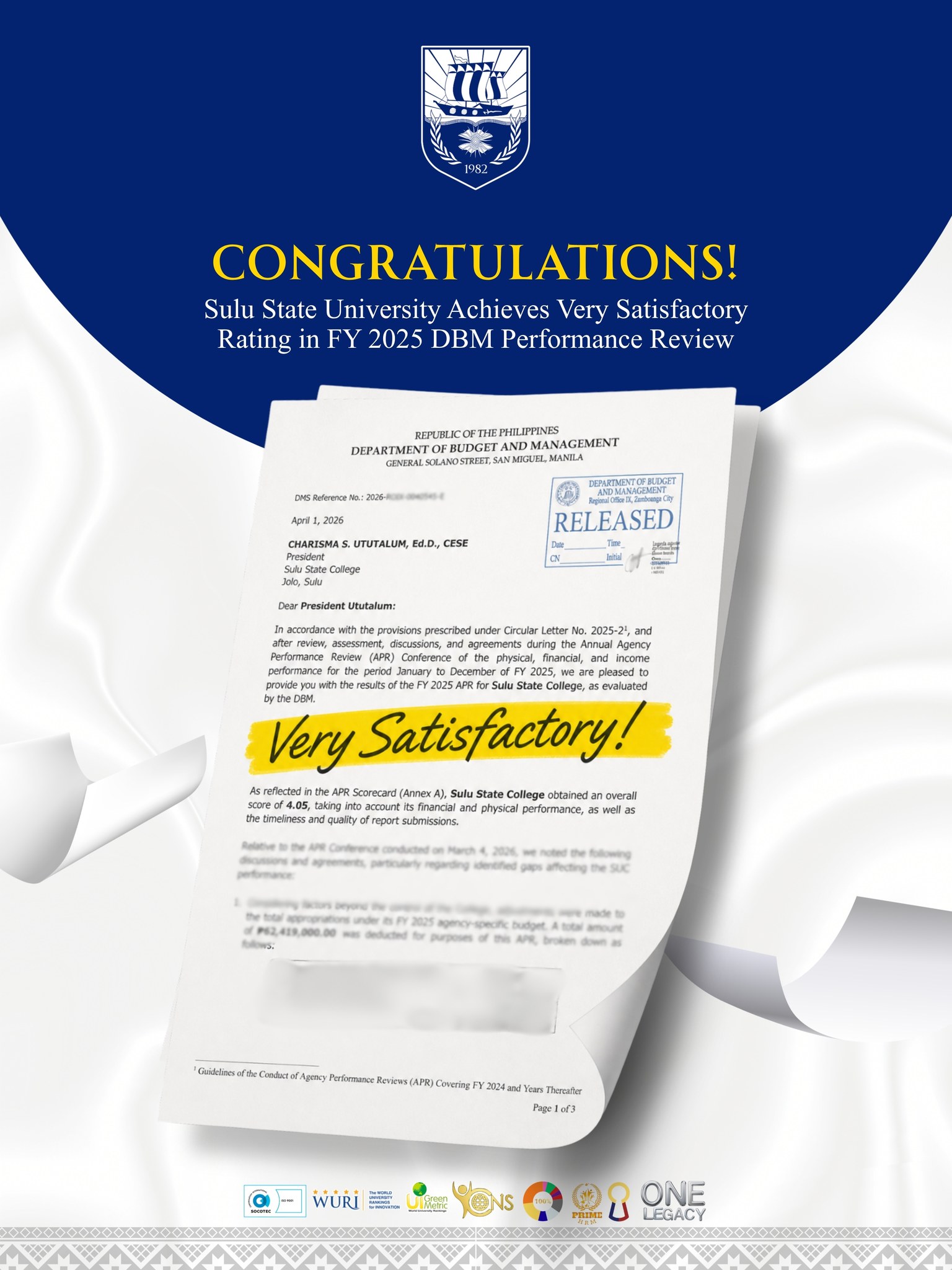
Sulu State University Achieves Very Satisfactory Rating in FY 2025 DBM Performance Review
Sulu State University proudly announces that it has achieved a VERY SATISFACTORY rating (4.05) in the FY 2025 Annual Performance Review (…
Read MoreFrom Sulu High School (1924) to Sulu State College today—official narrative, milestones, and the presidents who have led the institution.
Instruction, research, extension, and production—elemental functions that define Sulu State College’s mandate for national development.
Instruction, Research, Extension, and Production are elemental functions of the Sulu State College, its raison d’etre. The College strives for excellence in these areas and through its seven Schools, aims for programs and projects for human advancement. By its progressive expansion of knowledge in the fields of science, technology, agriculture and business entrepreneurship, the College is, to all intents and purposes, an instrument of the government for national development and improvement of the quality of life.
Sulu State College traces its origins to 1924 when the Americans established Sulu High School, which was the highest institution of learning in the entire Province of Sulu at that time. Over the years, the institution has undergone several organizational transformations, primarily in response to the growing educational needs of the developing region.
In 1963, by virtue of RA 3712, Sulu High School was renamed Dayang Hadji Piandao Memorial High School in honor of the late Pangian (Queen) of Sulu, in accordance with Republic Act No. 3712. While Dayang Hadji Piandao Memorial High School received national government support, in 1970, the provincial government established Jolo Community College, which quickly grew to serve an average of 1,200 enrollees. The college was primarily funded through tuition fees and other student charges.
In 1982, the two institutions merged and became Sulu State College, pursuant to Batas Pambansa Bilang 208. As a result of this law, Mr. Mukatil U. Salih became the acting president of the College until his retirement in 1989. Since then, three other educators have served as president: Dr. Norma A. Abdulla (1989–1995), Dr. Hamsali S. Jawali (1995–2010), and Dr. Abdurasa S. Arasid (2010–2018).
Dr. Abdulla's tenure was marked by the advent of computerization, which introduced office automation to the College. During her administration, she established the Graduate School program and took several steps to further develop the institution. The computer center, which preceded the establishment of the School of Computer Science, was where students took their computer literacy classes. At the beginning of her presidency, Sulu State College consisted of only four schools: Education, Arts and Sciences, Business Administration, and Agriculture.
During Dr. Hamsali's presidency, additional academic programs were introduced, and two new schools were established—the School of Computer Science, Information Technology, and Engineering, and the School of Nursing. Additionally, the Islamic Studies was founded. By the time Dr. Arasid assumed office, he continued the focus on quality education set by his predecessors. To further this goal, he submitted the College's education program for accreditation, marking a first for Sulu State College.
Currently, the College is led by Dr. Charisma S. Ututalum, CESE, who was elected and appointed by the Board of Regents on June 21, 2018. Under Dr. Ututalum's leadership, Sulu State College has achieved significant milestones in administration, academics, research, and extension services. Notably, the College established the first Center for Culture and Arts in Sulu, the only Smart Campus in the province, and the first Open Market Organic Center, demonstrating a commitment to sustainable development. It has also increased student enrollment, improved facilities (including CCTV, water systems, and infrastructures), and formalized key operational frameworks. Dr. Ututalum expanded academic offerings, accrediting 31 programs with Certificate of Program Compliance and establishing new courses in fields like Criminology, Social Work, Public Administration, Tourism, Hospitality Management, Early Childhood Education and Nursing. The College also strengthened ties with local and national stakeholders, partnered with international research bodies, and implemented development programs for faculty and non-teaching personnel. Furthermore, the College became ISO 9001:2015 certified, Freedom of Information-compliant, received the Rising Star FOI award, and introduced innovations such as automated student services system. Dr. Ututalum's initiatives have also enhanced faculty and student welfare, with free licensure reviews, scholarships, and training programs, while fostering a culture of excellence, professionalism, and community engagement.
| Name | Term |
|---|---|
| Mukatil U. Salih | March 23, 1984 to May 24, 1989 |
| Norma A. Abdulla, EdD | May 25, 1989 to June 09, 1995 |
| Hamsali S. Jawali, EdD | April 17, 1996 to May 13, 2010 |
| Abdurasa S. Arasid, EdD | May 14, 2010 to May 13, 2018 |
| Prof. Charisma S. Ututalum, EdD, CESE | June 21, 2018 to present |
Sulu State University proudly announces that it has achieved a VERY SATISFACTORY rating (4.05) in the FY 2025 Annual Performance Review (…
Read More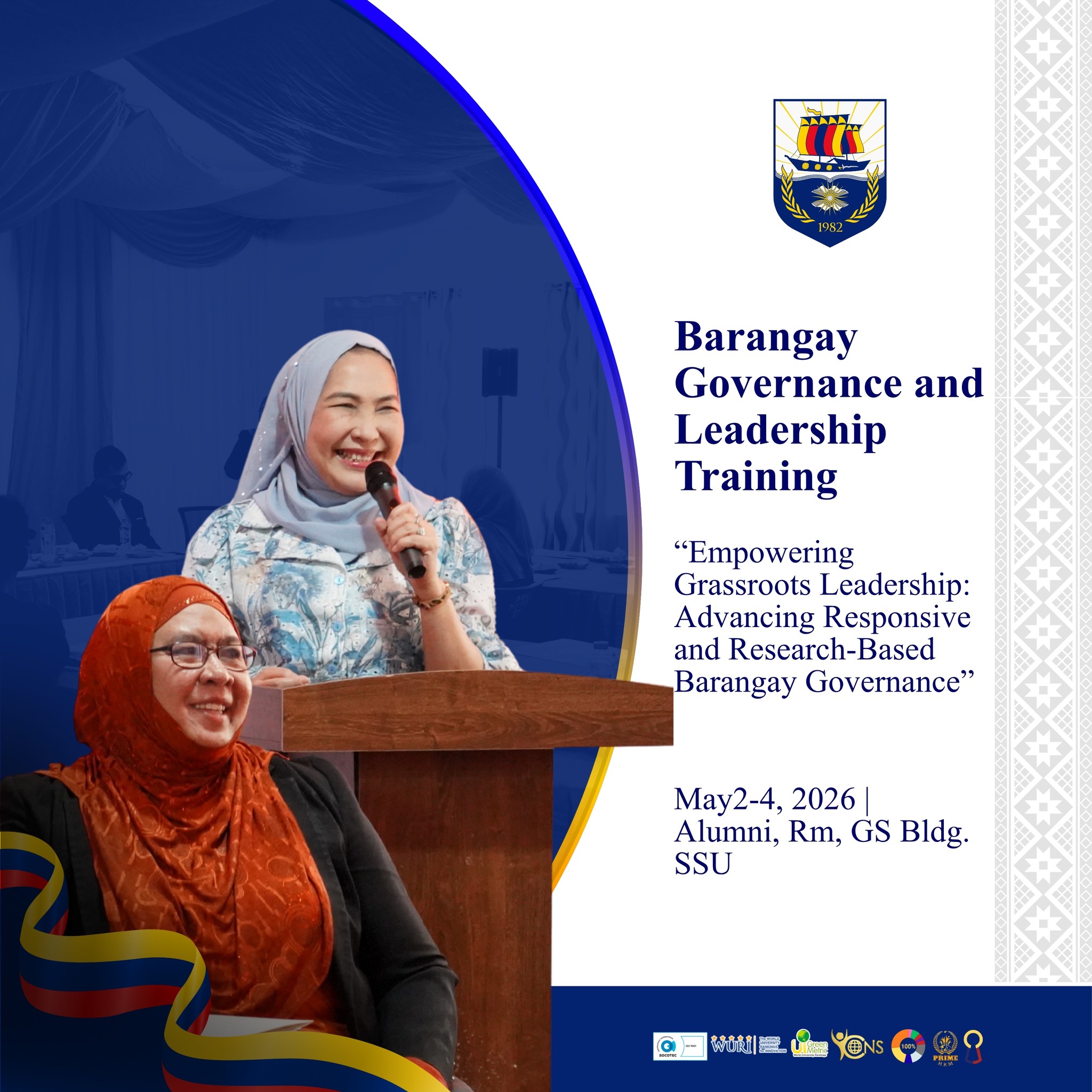
The Sulu State University School of Graduate Studies led by Prof. Masnona Asiri successfully conducted the Barangay Governance and Leader…
Read More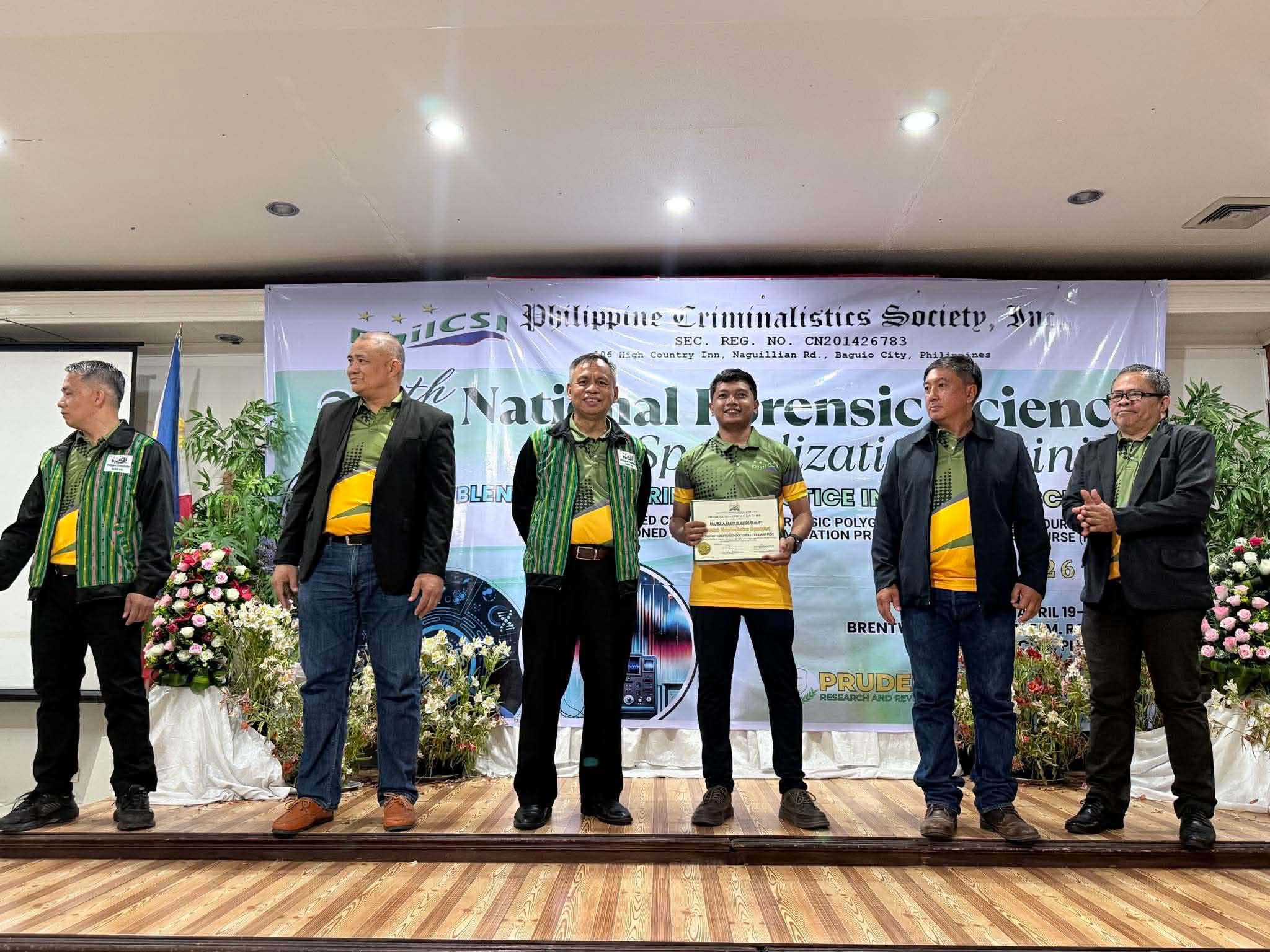
Sulu State University (SSU) led by Prof. Charisma Samparani Ututalum, CESE continues to uphold its commitment to academic excellence and …
Read More
In celebration of Labor Day, we honor all workers whose dedication and hard work continue to move our community forward. With heartfelt…
Read More